See where health financing evidence is strong — and where important gaps remain
Part of the Health Systems Financing (HSF) project, this evidence map brings together more than 36,000 studies published since 2010 that examine health financing functions — how health systems raise, pool and spend money. Explore what has been studied, where evidence is concentrated, how the field is changing, and which countries and health financing priorities remain underexplored.
Use Thematic analysis to discover key patterns, the Explorer to investigate the evidence in detail, or Countries to compare settings and examine a specific country.
The evidence base at a glance
Annual studies by publication year; 2026 is a partial year.
Explore key patterns in the global health financing evidence base.
Browse the complete set of thematic analyses, from evidence growth and financing functions to geography, methods, funding and access.
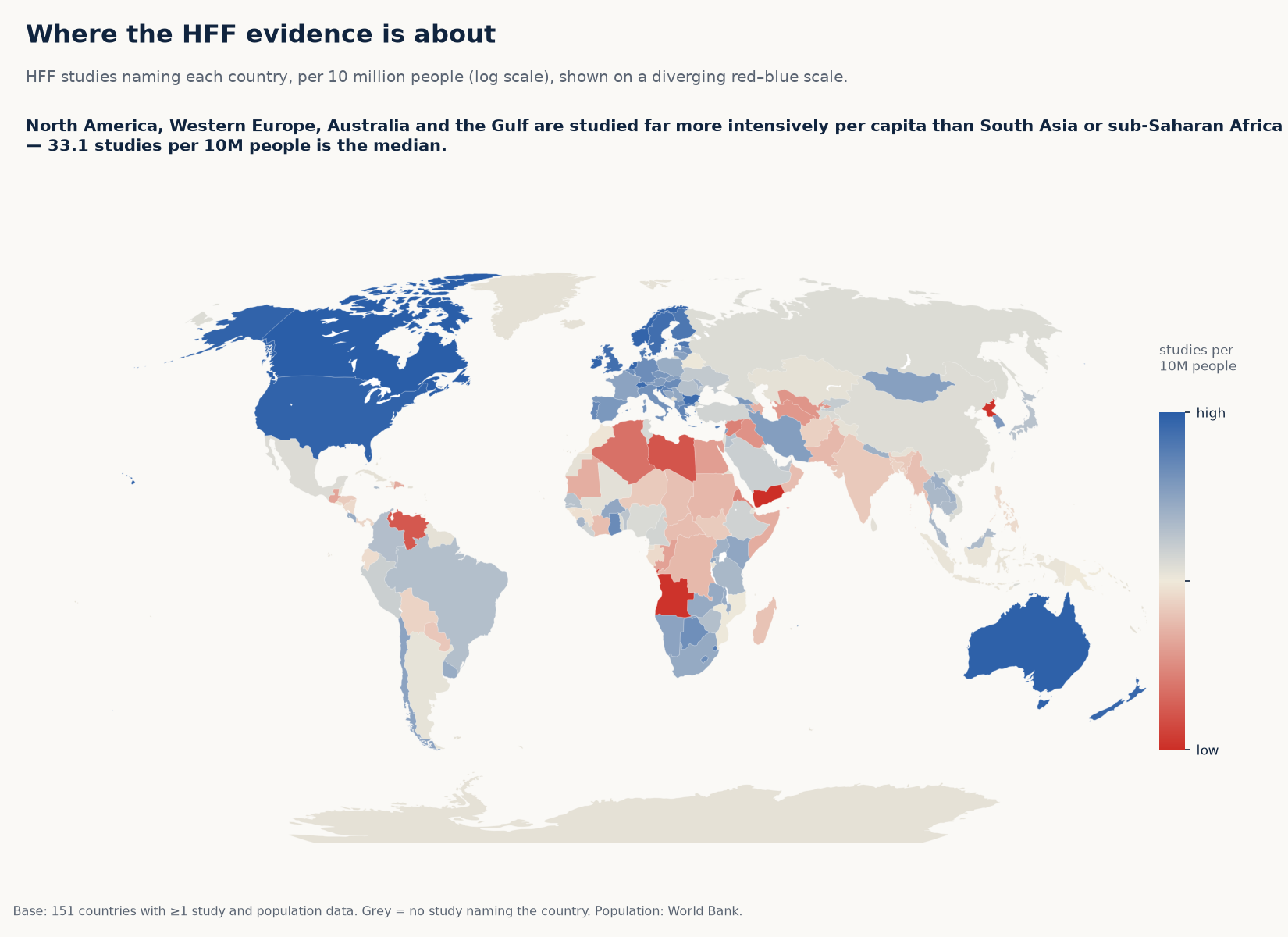
Every country by disease burden, health spending per person, and income group — bubble size is the number of HFF studies naming that country. Click a bubble to see that country's financing-function and outcome-domain spread below. Unfiltered — shows the whole dataset, independent of the Explorer tab's filters.
Row shares: of this country's studies reporting each outcome domain, the share that also carry each financing-function tag. A study can carry more than one tag of either kind. Click a cell to read the title and abstract of every study behind it.
Grid of study counts by financing function and year. Click a cell to open all of that country's studies for that function and year at once. Reflects whatever filters are set in the Explorer tab.
Every record's title and abstract is classified by an ensemble of LLMs (GLM, Claude Sonnet, DeepSeek) against the health-financing-function taxonomy — Revenue raising, Pooling, Purchasing, Benefits decisions, Public financial management, plus recurrent and capital-investment financing — with a consensus step across models. Records that no model places in any bucket, or that stay Unclear after consensus, are screened out before full extraction.
Records that pass the bucket screen go through full field extraction: study design, type of analysis, data type and source, unit of observation, geography, outcome domain, and (for Revenue-raising studies) sub-questions on external/donor and non-governmental financing mechanisms. A DOI-recovery and MeSH/OpenAlex topic harvest runs on the extracted set.
| Pipeline stage | Records |
|---|
| Input | Source |
|---|---|
| Health-financing framework and coding definitions | WHO health-financing framework; World Health Report 2010; Health System Performance Assessment; and CGD supply-chain financing framework. |
| Evidence-map scope and eligibility criteria | Marion et al. (2026), Systematic mapping of recent global research on health system financing using machine learning: Extended data. |
| Outcome-domain framework | WHO and European Observatory, Health System Performance Assessment: A Framework for Policy Analysis. Economic development uses a project-specific definition. |
| Study classification process | LLM-assisted extraction from titles and abstracts using GLM, Claude Sonnet and DeepSeek, with per-field consensus and human verification. This is the classification method, not the conceptual source of the financing framework. |
| Publication identifiers and links | Crossref REST API, OpenAlex and PubMed. |
| Research fields, topics and disease classifications | OpenAlex topic taxonomy supplies domain, field and subfield classifications. PubMed Medical Subject Headings (MeSH) supply disease and health-topic descriptors where available; OpenAlex topic metadata is used as fallback. These are external bibliographic classifications, not outputs of the LLM consensus process. |
| Country income groups, regions and population | World Bank country and lending groups, UN M49 regions and World Bank population data. |
| Disease burden and health-financing context | IHME Global Burden of Disease 2023 and IHME Financing Global Health. |
| Open access and author affiliations | OpenAlex work, open-access and authorship metadata, matched through recovered DOIs. |
| Research funders | Funder acknowledgements extracted from publication metadata and name-normalized within this project; figures state their analytical base and multi-funder counting convention. |
A study can cover more than one financing function or outcome area. It is counted once in each category it is tagged with. This means percentages in the Explorer can add up to more than 100%.
Multi-country studies are counted once in each country they cover. In country-level views, the same study can therefore appear under several countries. The “Studies in view” total still counts each study only once.
Country-level views use the geographic information extracted from each study and match it to a standard country reference list. A small number of places identified in the studies — including Taiwan, Israel, Kazakhstan and Cuba — are not included in that reference list. They therefore do not appear in the map, country table or country profiles, but the studies are still included in all other charts and totals.
“NA” values are not shown as a separate category. If a study could not be assigned a financing function or outcome area, it simply has no tag for that dimension rather than being placed in an artificial “unknown” category. “Other” and “Unclear” are retained as visible categories where they were assigned during classification.
Classification is LLM-based with a cross-model consensus step, not independently human-verified. Geography is free text matched against a fixed country list, so genuine geographies outside that list are excluded from country-level figures (see above). DOI and MeSH/topic coverage are partial. Disease-burden and health-spending figures are country-level reference data, not something extracted from the studies — comparisons against them are ecological, not causal.
| Criteria | Description |
|---|---|
| Population | Global |
| Interest | Evidence on recurrent financing of health system services; capital investments; links to the supply chain; and the consequences for health-system and societal goals. |
| Context | No limitations based on location (geographic or health setting) or health characteristics. |
| Study design | All types of empirical studies using qualitative, quantitative or mixed-methods approaches are included. For non-economic evaluations, no restriction is placed on methodological rigour. For economic evaluations, only studies comparing both costs and benefits and two or more alternative methods of delivering care are included. |
| Time and scope | Published articles and reviews published since 2010. English-only search terms are used, but no language restrictions are placed on included studies. |
More detailed inclusion and exclusion criteria are available in Extended data, Appendices C and D: Marion, P., Lee, S., Lotfi, T., Hutchinson, B., Sempé, L., Pande, S., et al. (2026), Systematic mapping of recent global research on health system financing using machine learning. View the extended data ↗
These definitions describe the health-financing topics included in the evidence map.
Revenue raising
World Health Report 2010 definition. Revenue collection refers to the way money is raised to pay health-system costs. Money is typically received from households, organisations or companies, and sometimes from contributors outside the country (called external sources). Resources can be collected through general or specific taxation; compulsory or voluntary health-insurance contributions; direct out-of-pocket payments, such as user fees; and donations.
Health System Performance Assessment definition. Revenue raising refers to the ways in which money is brought into the health system. Revenue is collected through out-of-pocket payment at the point of service use, or through prepaid funds including insurance contributions and/or taxes. In part, the way money is generated for the health system depends on whether third-party payers in the system are public, and hence compulsory, or private, as either profit or not-for-profit models.
Revenue sources include those that are:
- Public: forms of taxation, which may or may not be specifically earmarked for health, including social health-insurance contributions, which are a form of earmarked tax.
- External: funds from external sources, usually as development assistance. This money is then channelled into the health system via the Ministry of Finance. Other forms of external funding may include foreign investment, though it is usually for capital investments.
- Private: funds from households or firms in the form of either voluntary prepayment or out-of-pocket payment. Health contributions from non-governmental organisations are also part of private revenue sources.
Schemes are the structural arrangements or systems through which money flows to health services and providers. Types of schemes include:
- Mandatory or automatic: participation for some or all people is mandatory by law and funded by obligatory contributions made by or on behalf of those individuals, or some people are automatically covered on a non-contributory basis from general budget revenues based on attributes such as citizenship, residence, poverty status or age.
- Voluntary: there are no government requirements; participation is voluntary.
Pooling
World Health Report 2010 definition. Pooling is the accumulation and management of financial resources to ensure that the financial risk of having to pay for health care is borne by all members of the pool and not by the individuals who fall ill. The main purpose of pooling is to spread the financial risk associated with the need to use health services. If funds are to be pooled, they have to be prepaid, before illness occurs, through taxes and/or insurance, for example. All health-financing systems include an element of pooling funded by prepayment, combined with direct payments from individuals to service providers, sometimes called cost sharing, co-payments, user charges, user fees or co-insurance.
Health System Performance Assessment definition. Pooling refers to the accumulation of prepaid funds that can be used to purchase goods and services on behalf of a population. Some systems will have a single pool that may consolidate funding from different revenue-raising sources; other systems might have multiple pools. Pooling arrangements set the potential for prepaid funds to be redistributed across a particular population. Some form of resource-allocation or equalisation formula might be used to help ensure that each pool has an allocation appropriate for the population it covers.
Purchasing
World Health Report 2010 definition. Purchasing is the process of paying for health services. There are three main ways to do this. One is for government to provide budgets directly to its own health-service providers, integrating purchasing and provision, using general government revenues and, sometimes, insurance contributions. The second is for an institutionally separate purchasing agency, such as a health-insurance fund or government authority, to purchase services on behalf of a population. The third is for individuals to pay a provider directly for services. Many countries use a combination. Within these broad areas, health-service providers can be paid in many different ways. Purchasing also includes deciding which services should be financed, including the mix between prevention, promotion, treatment and rehabilitation.
Health System Performance Assessment definition. Purchasing, or commissioning, refers to payers using funds to pay for health care on behalf of a population; it reflects actual expenditures on behalf of different individuals in the population. Purchasing differs from procurement. Purchasing refers specifically to payment for services or items such as medicines and other supplies used in care provision, whereas procurement is the process of obtaining inputs and includes both commodities, such as medicines and laboratory supplies, and aspects of capital investment, such as medical devices. Procurement issues are considered under recurrent financing for the procurement and distribution of supply-chain inputs.
Active purchasing includes choosing to purchase only from accredited providers, purchasing only cost-effective services, and using payment mechanisms that incentivise more or less provision.
Passive purchasing includes arrangements in which funds, such as historical budget allocations or unmanaged fee-for-service payment to a provider, are not influenced by provider performance or efforts to influence the quantity or quality of health services.
Benefits decisions
Benefit design determines who can benefit from prepaid spending. Coverage policies determine who is covered, what the pooled public revenues will pay for, and any restrictions or conditions of access. All countries limit health-service entitlements in one way or another. Coverage-policy decisions determine the specifics of how benefits are rationed, and so influence health-system performance and progress towards universal health coverage goals.
Public financial management
Public financial management refers to the set of rules and mechanisms that govern the allocation, use and accountability of public funds. With respect to the health system in particular, the public financial management system plays a key role in the budgetary formulations that determine the level and allocation of public funding for health; the execution of that budget in terms of effectiveness and targeting of spending; and financial monitoring and transparency.
Capital investment: infrastructure
The policies and practices to acquire, upgrade or maintain infrastructure across the health system, inclusive of physical facilities, such as health centres and hospitals, medical equipment and digital infrastructure.
Capital investment: other health-system inputs
The policies and practices to train or grow the health workforce, inclusive of specialists, doctors, nurses, community health workers, carers and other health workers, and invest in the production of health products such as medicines and vaccines.
Recurrent financing for supply-chain inputs
The policies and practices necessary to provide financial resources to the supply chain, and ensure their optimal use, in order to achieve health-system goals. Supply chains include not just the commodities in the supply chain, but all the physical and informational resources required to deliver a good or service to the final consumer, including infrastructure such as warehouses, staffing, management, logistics and data systems. Policies and practices span four phases:
- Planning: developing strategic and operational plans to forecast demand, allocate resources and optimise supply-chain processes for effective health-care delivery.
- Procurement: managing the sourcing, contracting and procurement of health commodities to ensure continuous availability and minimise supply disruptions.
- Delivery: coordinating logistics, warehousing, transportation and inventory management to facilitate the efficient and timely distribution of health-care products.
- Monitoring: assessing supply-chain performance by tracking product and information flows and using data and technologies, human resources and financial management.
Definition sources
WHO, The World Health Report 2010: Health Systems Financing: The Path to Universal Coverage ↗
The capital-investment definitions are project definitions. The document notes that the Health System Performance Assessment definitions were supplemented with expert input from Joe Kutzin.
Seven definitions draw directly from, or use language from, the WHO Health System Performance Assessment framework. Economic development is defined specifically for this evidence map.
| Outcome domain | Definition and coding guidance |
|---|---|
| Equitable distribution of health-system resources | The extent to which the distribution of health care and its benefits among a population is fair. Health-service equity refers to the distribution of care quality and ensuring that it does not vary because of personal characteristics such as gender, ethnicity, geographic location or socioeconomic status. Code this outcome when a study assesses an outcome for an equity-relevant group relative to another demographic or socioeconomic group, or uses an explicit comparative measure of inequality or equity. Do not code it solely because the study covers an equity-relevant or disadvantaged group. |
| Efficiency in the use of resources | The relationship between a specific product (output) of the health system and the resources (inputs) used to create the product, distinguishing technical and allocative efficiency. |
| Quality of service provision | The degree to which health services for individuals and populations increase the likelihood of desired health outcomes and are consistent with current medical knowledge. |
| Transparency and accountability | Transparency is about the public availability of usable information, which ultimately allows scrutiny of public actors and their decisions. Accountability refers to how well the system is governed overall, as well as how well the governance of financing, service delivery and resource generation performs. At the heart of accountability is an accountability relationship: someone is accountable to someone else for something. |
| Improved level and distribution of health | Health improvement refers to improvement in the health of the population, where health includes different parts of the life cycle, morbidity and premature mortality. |
| Responsiveness to citizens | The extent to which the service-user perspective and experience of health care is measured and valued as an outcome of service delivery, including outcomes related to the perspectives and social preferences of individuals, carers, families and communities as participants in, and beneficiaries of, trusted health systems organised around people's comprehensive needs rather than individual diseases. |
| Financial protection | Safeguarding people against the financial hardship associated with paying for health services. |
| Economic development | The process by which the economic wellbeing and quality of life of a nation, region, local community or individual are improved according to targeted goals and objectives. Examples of impacts that health financing may have on economic development include, but are not limited to, labour-force opportunities, job creation, job mobility, business growth, investment decisions or macroeconomic growth. Goals, objectives or outcomes related only to the bottom line or financial health of a health-care organisation or private-sector entity are not classified as economic development. |
Other: When a record contains outcomes that do not fit any of the eight predefined domains, we classify them as Other and then analyse those outcomes thematically.
Unclear: The available title and abstract do not provide enough information to classify the outcome confidently.
Source: WHO, Health System Performance Assessment: A framework for policy analysis ↗